Research area

Explainable AI

Selective SHAP for IoT intrusion response gates and Grad-CAM for transparent crop-disease predictions.

Projects
3
Publications
2
Conference
2
Datasets
0
Software
1

Overview

Explainability at Nauman Irshad Lab is tied to decisions: CXG-DT and CARE-GATE use selective SHAP when risk gates open; crop disease detection uses Grad-CAM so predictions are inspectable for agricultural stakeholders.

Objectives

  1. Use explanations only when they change response behaviour under uncertainty.

  2. Provide visual explanations for agricultural AI demos and exhibitions.

Future directions

  • Operator studies on explanation usefulness for IDS response

Research images

From the laboratory

Explainable AI — laboratory imagery

Current projects

Projects in explainable ai

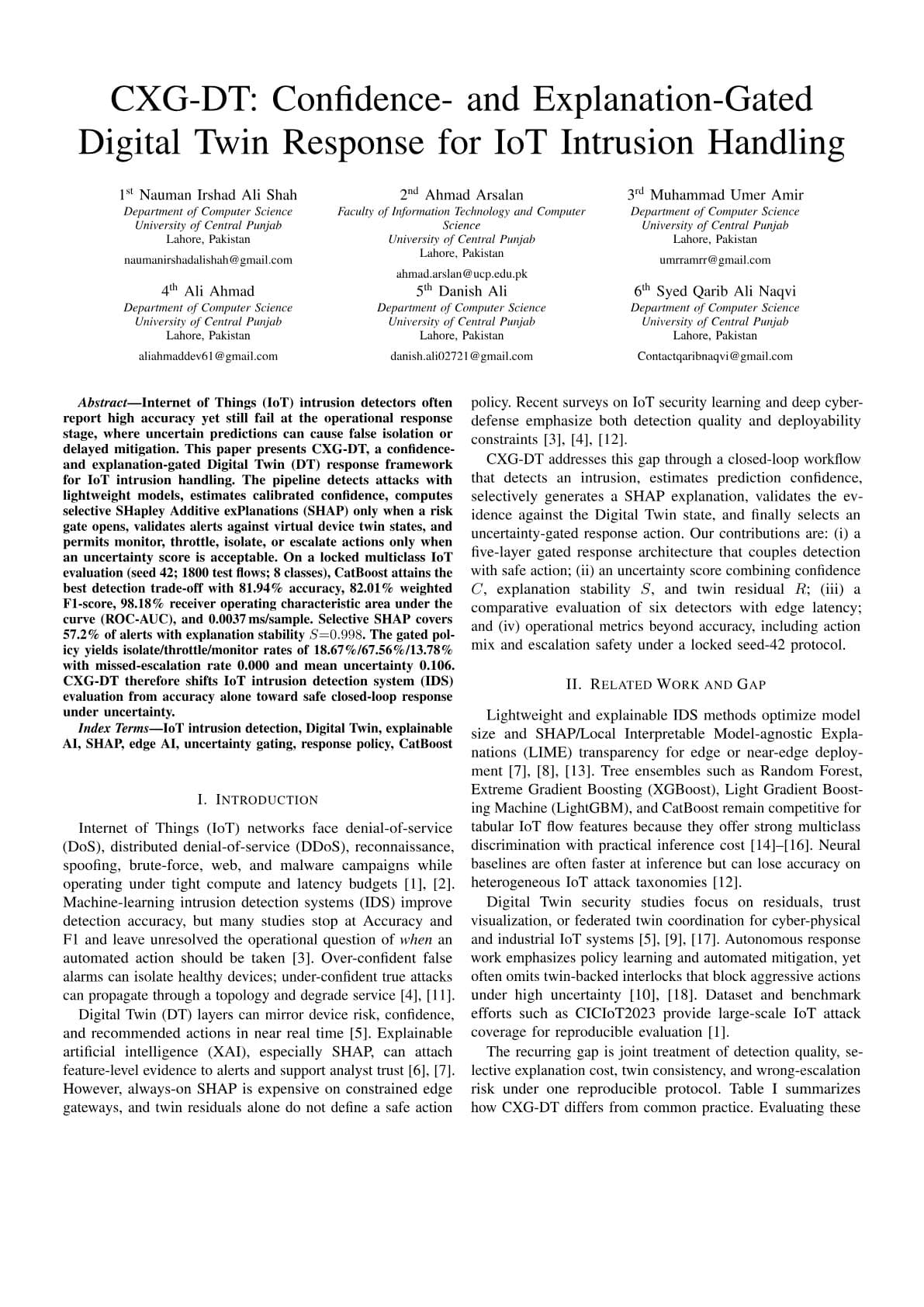
CXG-DT · Confidence- and Explanation-Gated Digital Twin IoT Response project imagery

CXG-DT · Confidence- and Explanation-Gated Digital Twin IoT Response

CXG-DT addresses the gap between high IDS accuracy and safe operational response. The pipeline detects attacks with lightweight models, estimates calibrated confidence, runs selective SHAP only when a risk gate opens, validates alerts against virtual device twin states, and permits monitor, throttle, isolate or escalate actions only when uncertainty is acceptable. Evaluated on a locked multiclass IoT set (CICIoT-style flows) with CatBoost as the primary detector.

Publications

Supervisor & research team

Click a photo to open LinkedIn

Technology stack

  • Python
  • CatBoost
  • SHAP
  • Digital Twin
  • scikit-learn
  • CICIoT2023

Paper · download & cite

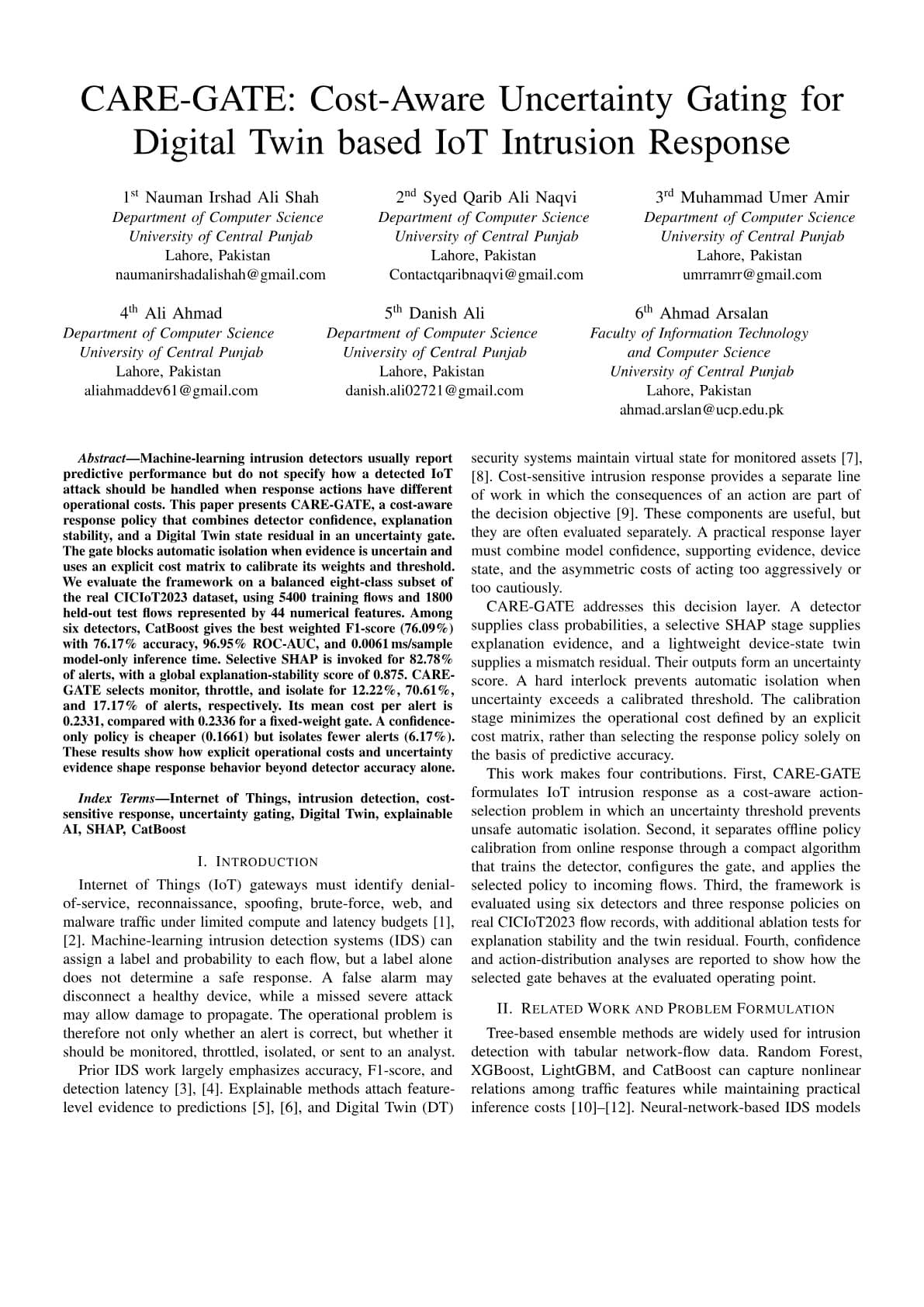
CARE-GATE · Cost-Aware Uncertainty Gating for DT Intrusion Response project imagery

CARE-GATE · Cost-Aware Uncertainty Gating for DT Intrusion Response

CARE-GATE focuses on the decision layer after detection: when should an IoT gateway isolate, throttle or only monitor? The framework uses an explicit cost matrix with uncertainty evidence from confidence scores, selective SHAP stability and twin-state residuals. Evaluated on a balanced eight-class CICIoT2023 subset with six detectors; CatBoost provides the best weighted F1 trade-off.

Supervisor & research team

Click a photo to open LinkedIn

Technology stack

  • Python
  • CatBoost
  • SHAP
  • Cost-sensitive learning
  • CICIoT2023

Paper · download & cite

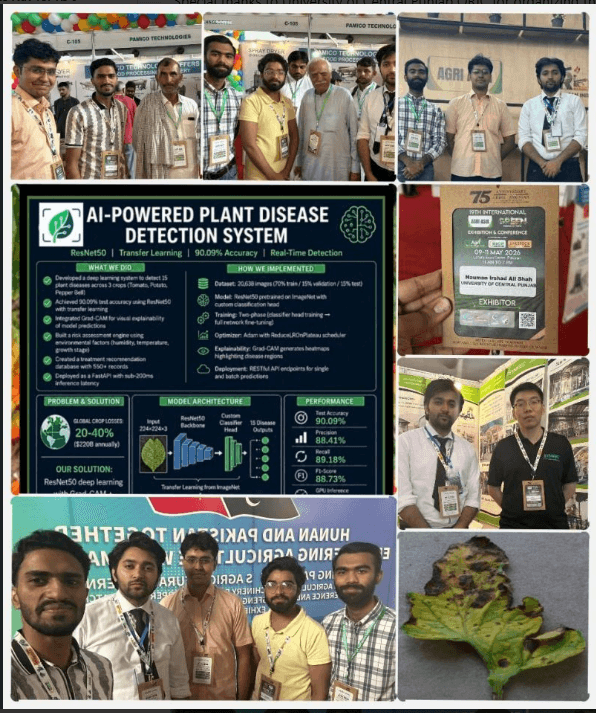
Crop Disease Detection · ResNet50 + Explainable AI for Agricultural Intelligence project imagery

Crop Disease Detection · ResNet50 + Explainable AI for Agricultural Intelligence

This AgriTech project detects 15 plant diseases across tomato, potato and pepper bell using 20,638 images, transfer learning on ResNet50 (ImageNet) and Explainable AI via Grad-CAM for transparent predictions. Reported metrics: 90.09% accuracy, 88.41% precision, 89.18% recall and 88.73% F1, with sub-200ms FastAPI inference. Presented as an exhibitor at the 19th International Agri Asia & Green Pakistan Exhibition & Conference (09–11 May 2026, Expo Centre Lahore). Team: Nauman Irshad Ali Shah, Ali Ahmad, Abdul Rehman, Danish Ali and Umer Amir.

Publications
In preparation

Technology stack

  • Python
  • ResNet50
  • PyTorch
  • Grad-CAM
  • FastAPI
  • Transfer Learning
  • Explainable AI

Publications

Peer-reviewed outputs in this area

First page of CARE-GATE: Cost-Aware Uncertainty Gating for Digital Twin based IoT Intrusion Response
Conference paperUnder review2026

CARE-GATE: Cost-Aware Uncertainty Gating for Digital Twin based IoT Intrusion Response

Nauman Irshad Ali Shah, Syed Qarib Ali Naqvi, Muhammad Umer Amir, Ali Ahmad, Danish Ali, Ahmad Arsalan

Conference manuscript · Digital Twin IoT intrusion response

Read abstract

Machine-learning intrusion detectors usually report predictive performance but do not specify how a detected IoT attack should be handled when response actions have different operational costs. This paper presents CARE-GATE, a cost-aware response policy that combines detector confidence, explanation stability, and a Digital Twin state residual in an uncertainty gate. The gate blocks automatic isolation when evidence is uncertain and uses an explicit cost matrix to calibrate its weights and threshold. Evaluated on a balanced eight-class subset of CICIoT2023, CatBoost gives the best weighted F1-score (76.09%). These results show how explicit operational costs and uncertainty evidence shape response behavior beyond detector accuracy alone.

Keywords: Internet of Things · intrusion detection · cost-sensitive response · uncertainty gating · Digital Twin · explainable AI · SHAP · CatBoost

PDFGitHub
First page of CXG-DT: Confidence- and Explanation-Gated Digital Twin Response for IoT Intrusion Handling
Conference paperUnder review2026

CXG-DT: Confidence- and Explanation-Gated Digital Twin Response for IoT Intrusion Handling

Nauman Irshad Ali Shah, Ahmad Arsalan, Muhammad Umer Amir, Ali Ahmad, Danish Ali, Syed Qarib Ali Naqvi

ICET / International Conference on Emerging Technologies (CMT submission)

Read abstract

Internet of Things (IoT) intrusion detectors often report high accuracy yet still fail at the operational response stage, where uncertain predictions can cause false isolation or delayed mitigation. This paper presents CXG-DT, a confidence- and explanation-gated Digital Twin (DT) response framework for IoT intrusion handling. The pipeline detects attacks with lightweight models, estimates calibrated confidence, computes selective SHAP only when a risk gate opens, validates alerts against virtual device twin states, and permits monitor, throttle, isolate, or escalate actions only when an uncertainty score is acceptable. On a locked multiclass IoT evaluation, CatBoost attains the best detection trade-off with 81.94% accuracy and 82.01% weighted F1-score. CXG-DT therefore shifts IoT IDS evaluation from accuracy alone toward safe closed-loop response under uncertainty.

Keywords: IoT intrusion detection · Digital Twin · explainable AI · SHAP · edge AI · uncertainty gating · CatBoost

PDFGitHub