Research area

Deep Learning

Deep models for agricultural disease detection (ResNet50 + XAI) and supporting vision pipelines used in PoseDepth and Smart Fitao AI.

Projects
4
Publications
2
Conference
1
Datasets
1
Software
1

Overview

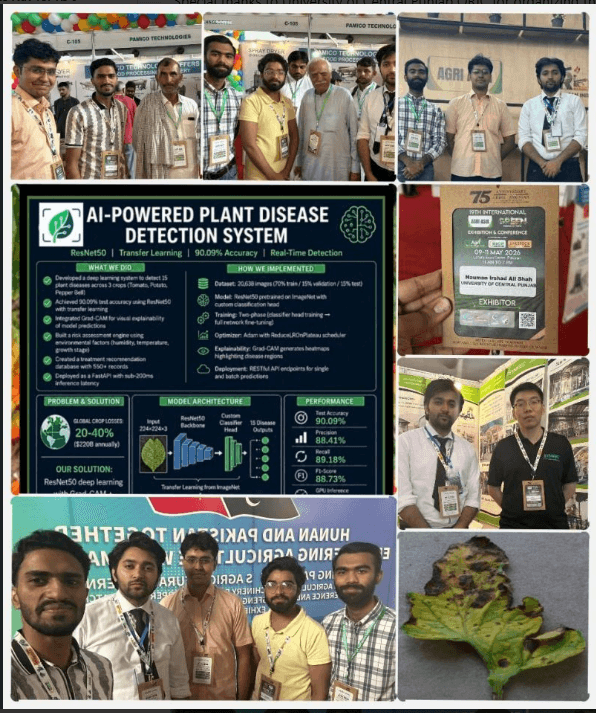
Deep learning at Nauman Irshad Lab is applied, not abstract: ImageNet-pretrained ResNet50 for 15 plant diseases with Grad-CAM explanations, reported at Agri Asia 2026 with 90.09% accuracy.

Related deep components support pose estimation and 3D human reconstruction in product and research demos.

Objectives

  1. Train and evaluate transfer-learning classifiers with honest metrics and XAI.

  2. Keep inference budgets suitable for FastAPI / edge-friendly demos.

Future directions

  • Broader crop species coverage
  • On-device model compression

Research images

From the laboratory

Deep Learning — laboratory imagery

Current projects

Projects in deep learning

PoseDepth-CMP · OpenPose COCO vs MPI for Person Depth Estimation project imagery

PoseDepth-CMP · OpenPose COCO vs MPI for Person Depth Estimation

PoseDepth-CMP gives practitioners evidence for choosing between OpenPose body-model variants for person-specific monocular depth. On 240 controlled samples, COCO reaches higher keypoint accuracy and lower depth error; MPI is faster and lighter. The project contributes paired statistics, cue ablations, uncertainty analysis and a learned adaptive selector.

Supervisor & research team

Click a photo to open LinkedIn

Technology stack

  • Python
  • OpenPose
  • COCO
  • MPI
  • Contour analysis
  • NumPy

Paper · download & cite

Download PDF
Smart Fitao AI · Cloth Size Prediction, 3D Try-On & Seller Studio (FYP) project imagery

Smart Fitao AI · Cloth Size Prediction, 3D Try-On & Seller Studio (FYP)

Smart Fitao AI asks: what if getting the perfect fit required no guesswork — just AI? The Final Year Project delivers (1) cloth size prediction for tailors from body and garment measurements, (2) 3D virtual try-on for a more personalised shopping experience, (3) a 24/7 AI chatbot with 3D product recommendations, and (4) a 3D studio for sellers to convert 2D products into interactive 3D models (including PIFuHD Metaverse finetuning). Presented at the Lahore Chamber of Commerce and Industry (LCCI). FYP advisor: Asif Farooq. Team: Nauman Irshad Ali Shah, Umer Amir, Ali Ahmad and Abdul Rehman.

Publications
In preparation

Technology stack

  • Python
  • PIFuHD
  • PyTorch
  • Flutter
  • Computer Vision
  • Metaverse
  • Chatbot
  • 3D Studio
Crop Disease Detection · ResNet50 + Explainable AI for Agricultural Intelligence project imagery

Crop Disease Detection · ResNet50 + Explainable AI for Agricultural Intelligence

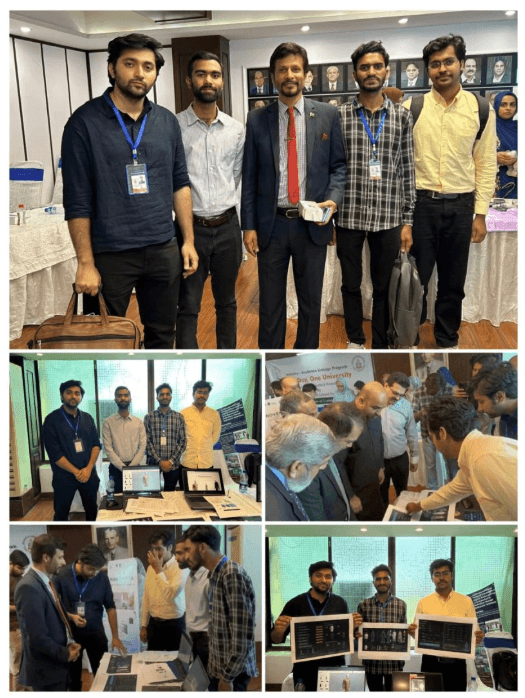
This AgriTech project detects 15 plant diseases across tomato, potato and pepper bell using 20,638 images, transfer learning on ResNet50 (ImageNet) and Explainable AI via Grad-CAM for transparent predictions. Reported metrics: 90.09% accuracy, 88.41% precision, 89.18% recall and 88.73% F1, with sub-200ms FastAPI inference. Presented as an exhibitor at the 19th International Agri Asia & Green Pakistan Exhibition & Conference (09–11 May 2026, Expo Centre Lahore). Team: Nauman Irshad Ali Shah, Ali Ahmad, Abdul Rehman, Danish Ali and Umer Amir.

Publications
In preparation

Technology stack

  • Python
  • ResNet50
  • PyTorch
  • Grad-CAM
  • FastAPI
  • Transfer Learning
  • Explainable AI
CodeVista · 3D Runner Learning Lab project imagery

CodeVista · 3D Runner Learning Lab

CodeVista 3D Runner is an educational coding lab led by teacher Asim Irshad. Students complete weekly programs, earn XP toward skill goals, and practise in a live 3D runner with Pause, Next, Replay and Run controls plus a source panel for the current exercise. Built for classroom and self-paced learning so beginners can see code behaviour while they write it. Live demo: https://codevista-3d-runner.vercel.app/

Publications
In preparation

Supervisor & research team

Click a photo to open LinkedIn

Technology stack

  • Flutter
  • 3D
  • Educational games
  • XP systems
  • Web

Publications

Peer-reviewed outputs in this area

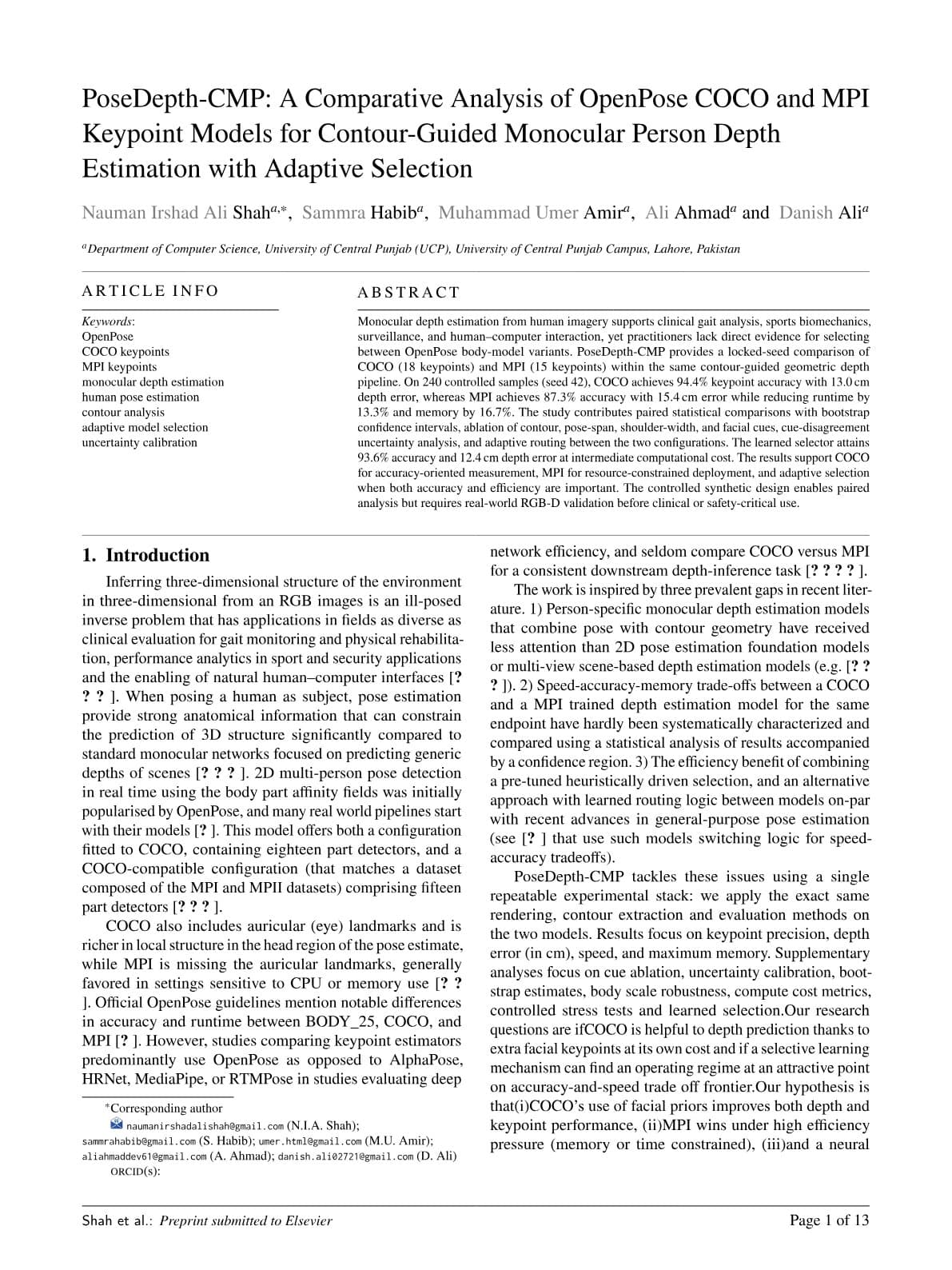
First page of PoseDepth-CMP: A Comparative Analysis of OpenPose COCO and MPI Keypoint Models for Contour-Guided Monocular Person Depth Estimation with Adaptive Selection
Journal paperUnder review2026

PoseDepth-CMP: A Comparative Analysis of OpenPose COCO and MPI Keypoint Models for Contour-Guided Monocular Person Depth Estimation with Adaptive Selection

Nauman Irshad Ali Shah, Sammra Habib, Muhammad Umer Amir, Ali Ahmad, Danish Ali

Journal manuscript · Computer Vision / Pose & Depth

Read abstract

Monocular depth estimation from human imagery supports clinical gait analysis, sports biomechanics, surveillance, and human–computer interaction, yet practitioners lack direct evidence for selecting between OpenPose body-model variants. PoseDepth-CMP provides a locked-seed comparison of COCO (18 keypoints) and MPI (15 keypoints) within the same contour-guided geometric depth pipeline. On 240 controlled samples (seed 42), COCO achieves 94.4% keypoint accuracy with 13.0 cm depth error, whereas MPI achieves 87.3% accuracy with 15.4 cm error while reducing runtime by 13.3% and memory by 16.7%. The learned selector attains 93.6% accuracy and 12.4 cm depth error at intermediate computational cost.

Keywords: OpenPose · COCO keypoints · MPI keypoints · monocular depth estimation · human pose estimation · adaptive model selection

PDF
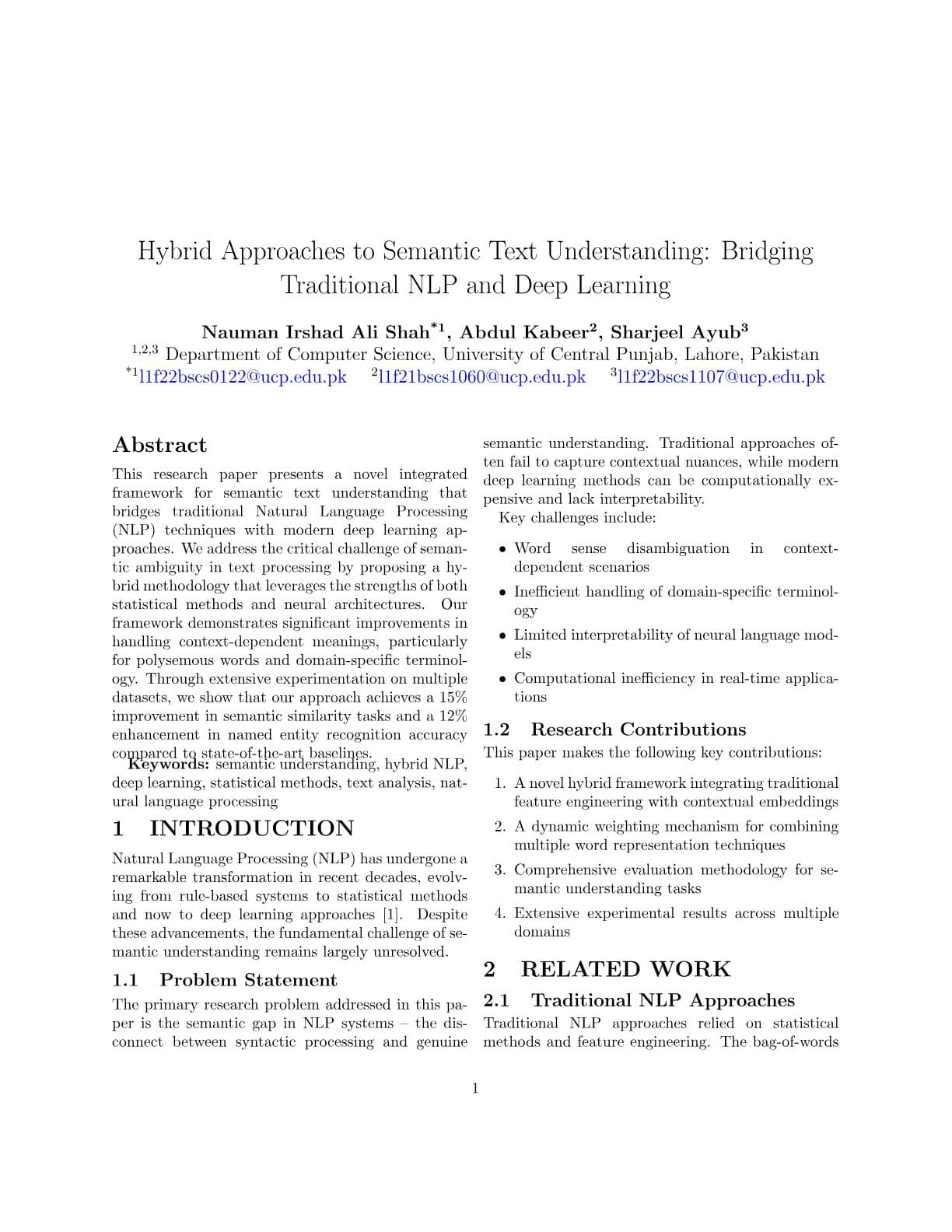
First page of Hybrid Approaches to Semantic Text Understanding: Bridging Traditional NLP and Deep Learning
Conference paperUnder review2025

Hybrid Approaches to Semantic Text Understanding: Bridging Traditional NLP and Deep Learning

Nauman Irshad Ali Shah, Abdul Kabeer, Sharjeel Ayub

Conference manuscript · Semantic NLP

Read abstract

This research paper presents a novel integrated framework for semantic text understanding that bridges traditional Natural Language Processing (NLP) techniques with modern deep learning approaches. We address semantic ambiguity by proposing a hybrid methodology that leverages statistical methods and neural architectures. Through experimentation on multiple datasets, the approach achieves a 15% improvement in semantic similarity tasks and a 12% enhancement in named entity recognition accuracy compared to baselines.

Keywords: semantic understanding · hybrid NLP · deep learning · statistical methods · natural language processing

PDF