Publications

Publication database

Every peer-reviewed output of the laboratory, with abstracts, keywords, identifiers and links to the code and data required to reproduce the results.

5

Total records

2

Journal papers

3

Conference papers

0

Book chapters

2025

Earliest year

Search and filter

Find a paper by author, year, keyword, venue or research area

Filters combine: selecting two types shows both, while adding a year narrows the result set. Everything runs locally in your browser.

Multiple terms are combined — “khan drift” matches records containing both.

5

publications shown

Publication type
Status
Year
Research area
Journal or conference
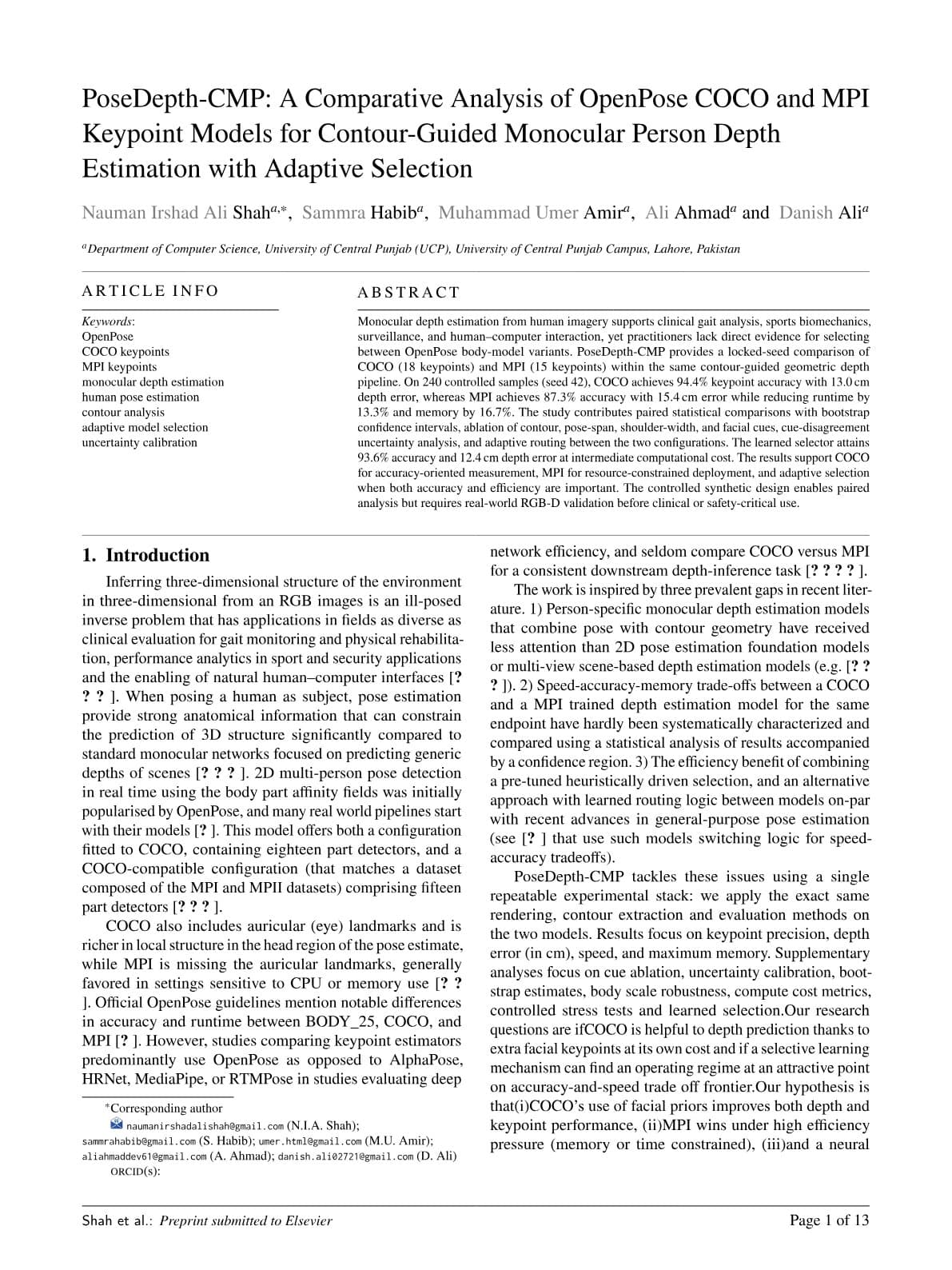
First page of PoseDepth-CMP: A Comparative Analysis of OpenPose COCO and MPI Keypoint Models for Contour-Guided Monocular Person Depth Estimation with Adaptive Selection
Journal paperUnder review2026

PoseDepth-CMP: A Comparative Analysis of OpenPose COCO and MPI Keypoint Models for Contour-Guided Monocular Person Depth Estimation with Adaptive Selection

Nauman Irshad Ali Shah, Sammra Habib, Muhammad Umer Amir, Ali Ahmad, Danish Ali

Journal manuscript · Computer Vision / Pose & Depth

Read abstract

Monocular depth estimation from human imagery supports clinical gait analysis, sports biomechanics, surveillance, and human–computer interaction, yet practitioners lack direct evidence for selecting between OpenPose body-model variants. PoseDepth-CMP provides a locked-seed comparison of COCO (18 keypoints) and MPI (15 keypoints) within the same contour-guided geometric depth pipeline. On 240 controlled samples (seed 42), COCO achieves 94.4% keypoint accuracy with 13.0 cm depth error, whereas MPI achieves 87.3% accuracy with 15.4 cm error while reducing runtime by 13.3% and memory by 16.7%. The learned selector attains 93.6% accuracy and 12.4 cm depth error at intermediate computational cost.

Keywords: OpenPose · COCO keypoints · MPI keypoints · monocular depth estimation · human pose estimation · adaptive model selection
PDF
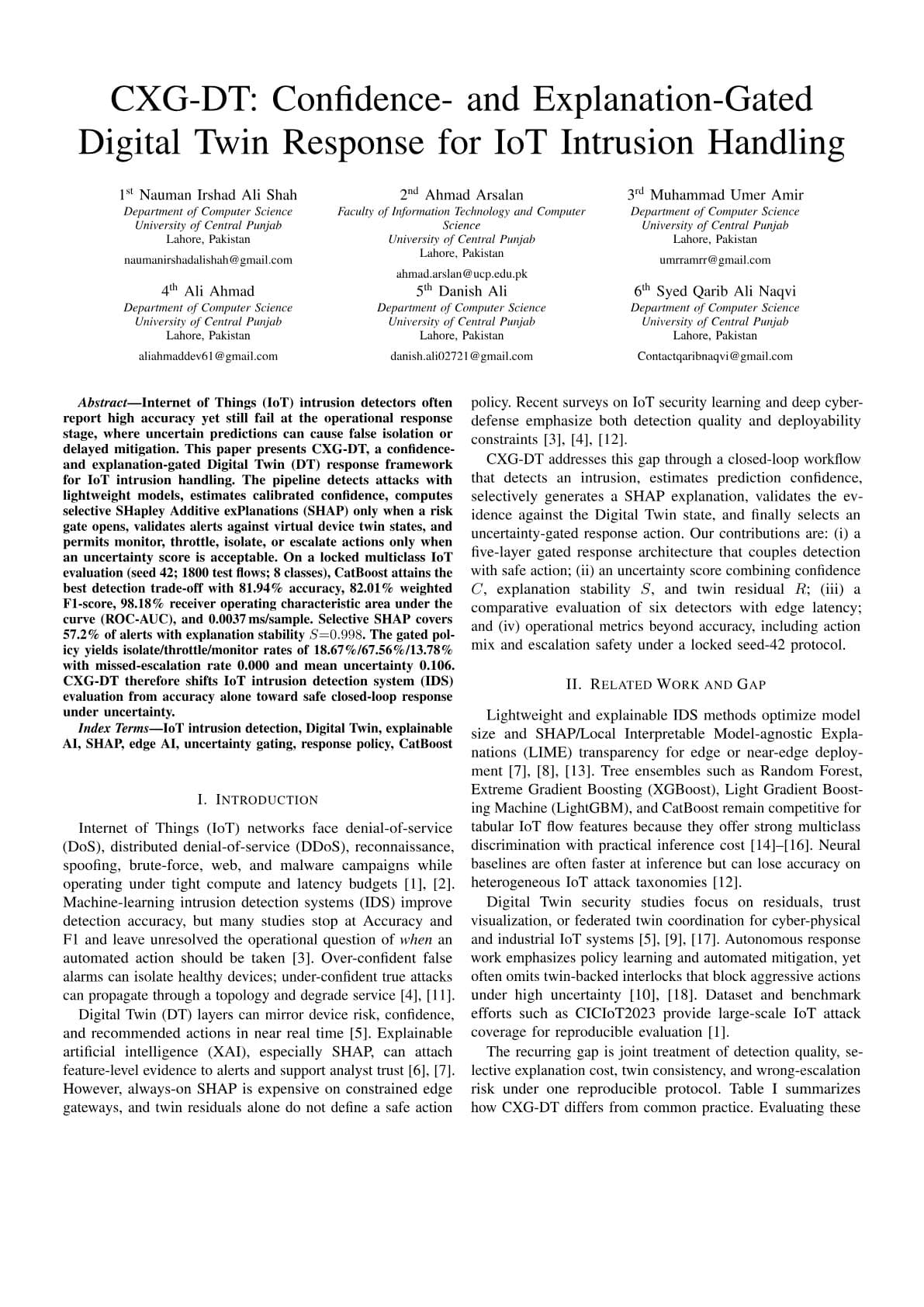
First page of CXG-DT: Confidence- and Explanation-Gated Digital Twin Response for IoT Intrusion Handling
Conference paperUnder review2026

CXG-DT: Confidence- and Explanation-Gated Digital Twin Response for IoT Intrusion Handling

Nauman Irshad Ali Shah, Ahmad Arsalan, Muhammad Umer Amir, Ali Ahmad, Danish Ali, Syed Qarib Ali Naqvi

ICET / International Conference on Emerging Technologies (CMT submission)

Read abstract

Internet of Things (IoT) intrusion detectors often report high accuracy yet still fail at the operational response stage, where uncertain predictions can cause false isolation or delayed mitigation. This paper presents CXG-DT, a confidence- and explanation-gated Digital Twin (DT) response framework for IoT intrusion handling. The pipeline detects attacks with lightweight models, estimates calibrated confidence, computes selective SHAP only when a risk gate opens, validates alerts against virtual device twin states, and permits monitor, throttle, isolate, or escalate actions only when an uncertainty score is acceptable. On a locked multiclass IoT evaluation, CatBoost attains the best detection trade-off with 81.94% accuracy and 82.01% weighted F1-score. CXG-DT therefore shifts IoT IDS evaluation from accuracy alone toward safe closed-loop response under uncertainty.

Keywords: IoT intrusion detection · Digital Twin · explainable AI · SHAP · edge AI · uncertainty gating · CatBoost

PDFGitHub
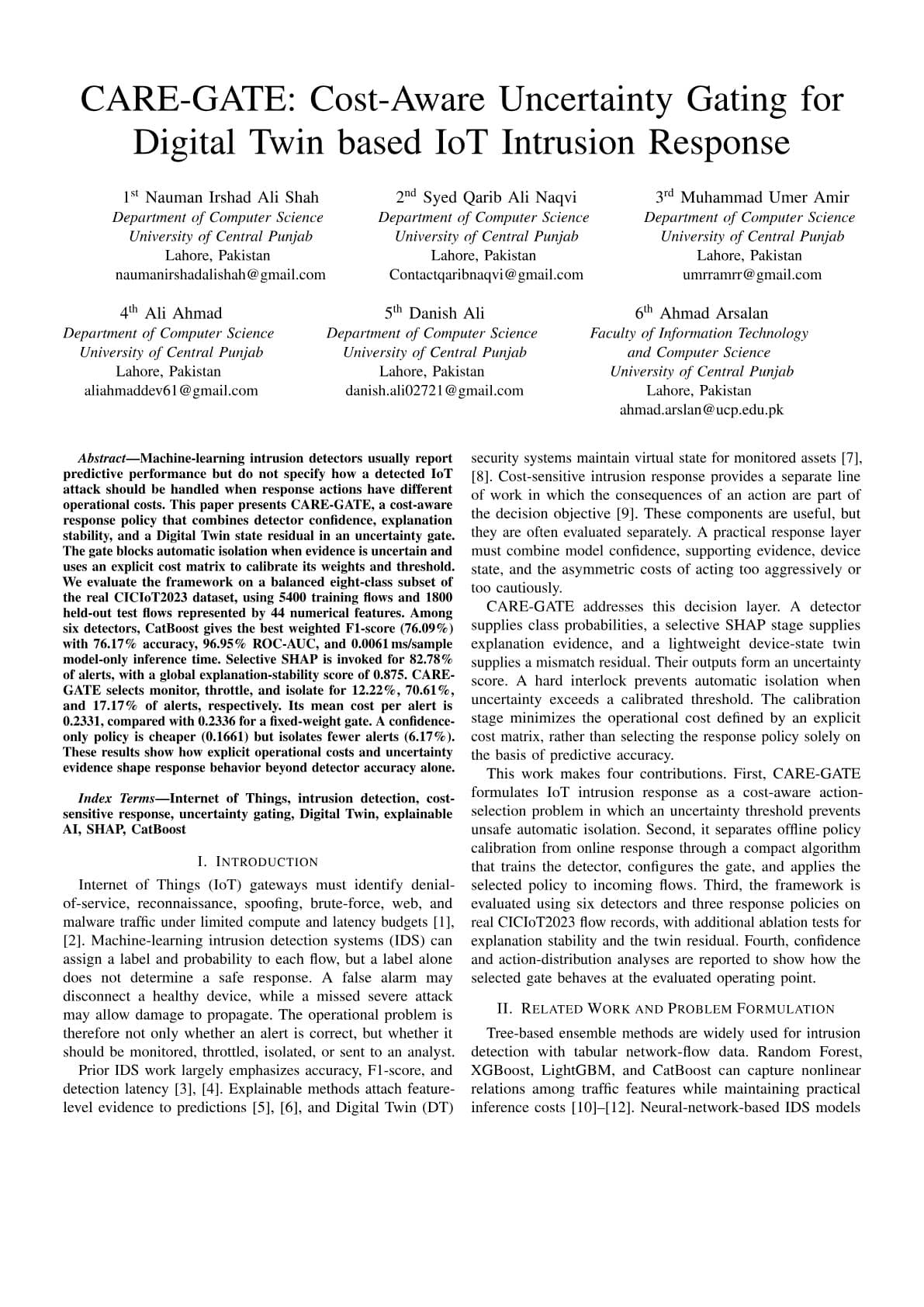
First page of CARE-GATE: Cost-Aware Uncertainty Gating for Digital Twin based IoT Intrusion Response
Conference paperUnder review2026

CARE-GATE: Cost-Aware Uncertainty Gating for Digital Twin based IoT Intrusion Response

Nauman Irshad Ali Shah, Syed Qarib Ali Naqvi, Muhammad Umer Amir, Ali Ahmad, Danish Ali, Ahmad Arsalan

Conference manuscript · Digital Twin IoT intrusion response

Read abstract

Machine-learning intrusion detectors usually report predictive performance but do not specify how a detected IoT attack should be handled when response actions have different operational costs. This paper presents CARE-GATE, a cost-aware response policy that combines detector confidence, explanation stability, and a Digital Twin state residual in an uncertainty gate. The gate blocks automatic isolation when evidence is uncertain and uses an explicit cost matrix to calibrate its weights and threshold. Evaluated on a balanced eight-class subset of CICIoT2023, CatBoost gives the best weighted F1-score (76.09%). These results show how explicit operational costs and uncertainty evidence shape response behavior beyond detector accuracy alone.

Keywords: Internet of Things · intrusion detection · cost-sensitive response · uncertainty gating · Digital Twin · explainable AI · SHAP · CatBoost

PDFGitHub
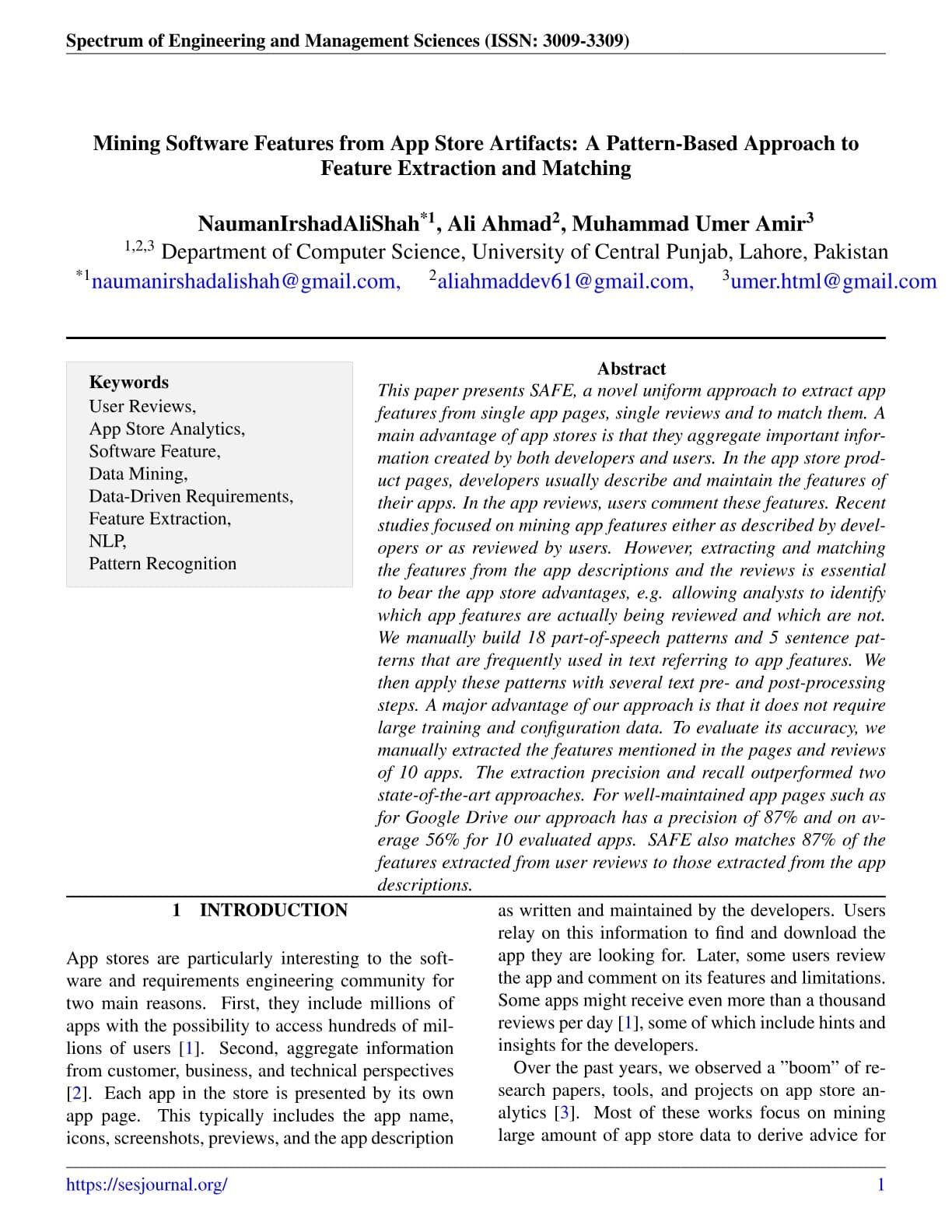
First page of Mining Software Features from App Store Artifacts: A Pattern-Based Approach to Feature Extraction and Matching
Journal paperPublished2025

Mining Software Features from App Store Artifacts: A Pattern-Based Approach to Feature Extraction and Matching

Nauman Irshad Ali Shah, Ali Ahmad, Muhammad Umer Amir

Spectrum of Engineering and Management Sciences · Spectrum of Engineering and Management Sciences

Read abstract

This paper presents SAFE, a novel uniform approach to extract app features from single app pages, single reviews and to match them. We manually build 18 part-of-speech patterns and 5 sentence patterns that are frequently used in text referring to app features, then apply these patterns with several text pre- and post-processing steps. A major advantage is that it does not require large training and configuration data. For well-maintained app pages such as Google Drive the approach has a precision of 87% and on average 56% for 10 evaluated apps. SAFE also matches 87% of the features extracted from user reviews to those extracted from the app descriptions.

Keywords: User Reviews · App Store Analytics · Software Feature · Data Mining · NLP · Pattern Recognition

PDF
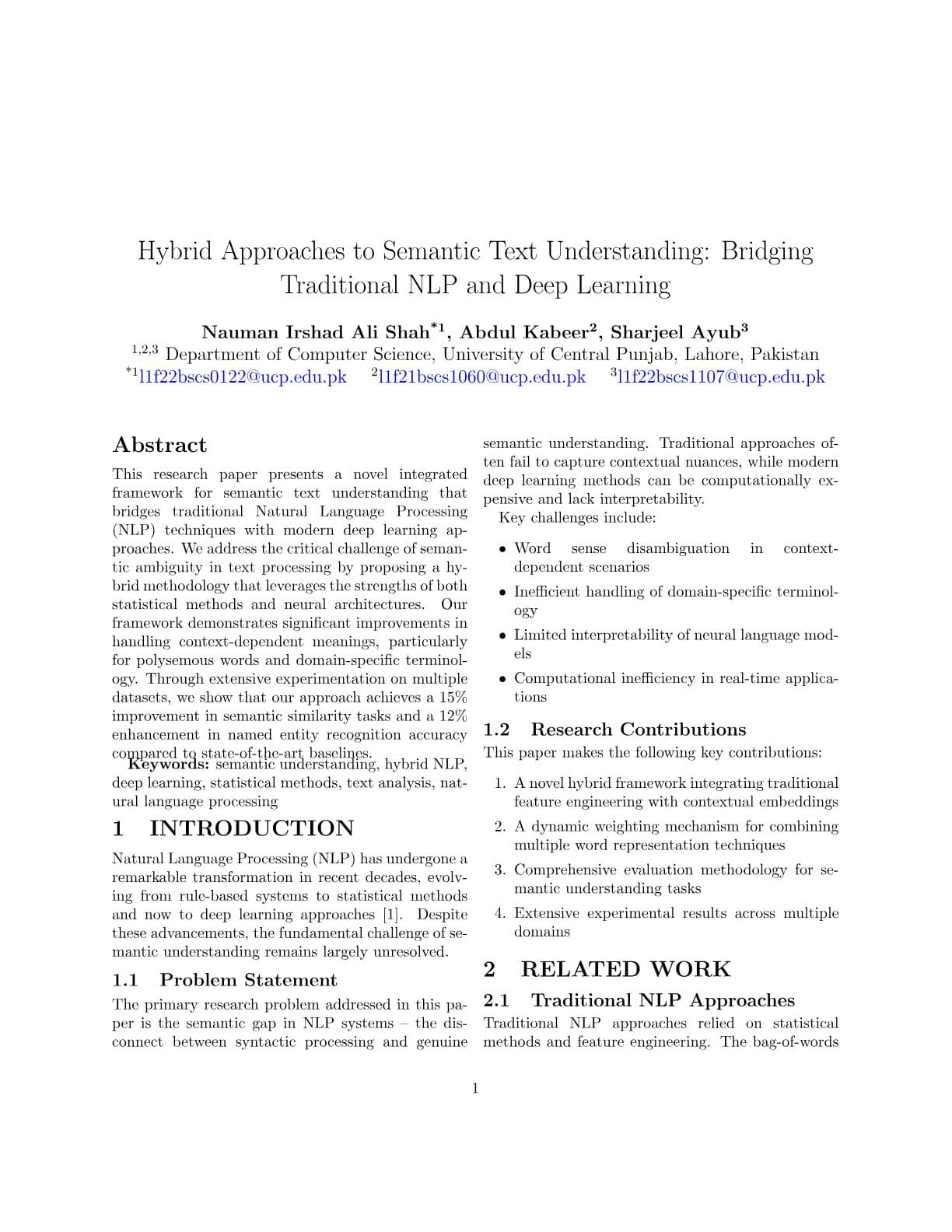
First page of Hybrid Approaches to Semantic Text Understanding: Bridging Traditional NLP and Deep Learning
Conference paperUnder review2025

Hybrid Approaches to Semantic Text Understanding: Bridging Traditional NLP and Deep Learning

Nauman Irshad Ali Shah, Abdul Kabeer, Sharjeel Ayub

Conference manuscript · Semantic NLP

Read abstract

This research paper presents a novel integrated framework for semantic text understanding that bridges traditional Natural Language Processing (NLP) techniques with modern deep learning approaches. We address semantic ambiguity by proposing a hybrid methodology that leverages statistical methods and neural architectures. Through experimentation on multiple datasets, the approach achieves a 15% improvement in semantic similarity tasks and a 12% enhancement in named entity recognition accuracy compared to baselines.

Keywords: semantic understanding · hybrid NLP · deep learning · statistical methods · natural language processing

PDF

Citing our work

BibTeX and formatted references are available on every record

Use the Cite button for an IEEE-style reference or BibTeX to copy a ready-to-paste entry. If a PDF is not available for licensing reasons, email us and we will send the author copy.